Did you know?
The world's longest traffic jam stretched over 100 km in China in 2010.
AutoThrust India
The latest car launches, in-depth reviews, variant price updates, and expert insights from India's roads.
Did you know?
The average car has around 30,000 individual parts.
Did you know?
The world's longest traffic jam stretched over 100 km in China in 2010.
India's transition towards cleaner and more sustainable fuels has brought ethanol-blended petrol into the spotlight. While the government's ethanol blending programme aims to reduce fuel imports and lower emissions, concerns about the long-term effects of E20 petrol continue to grow among vehicle owners.
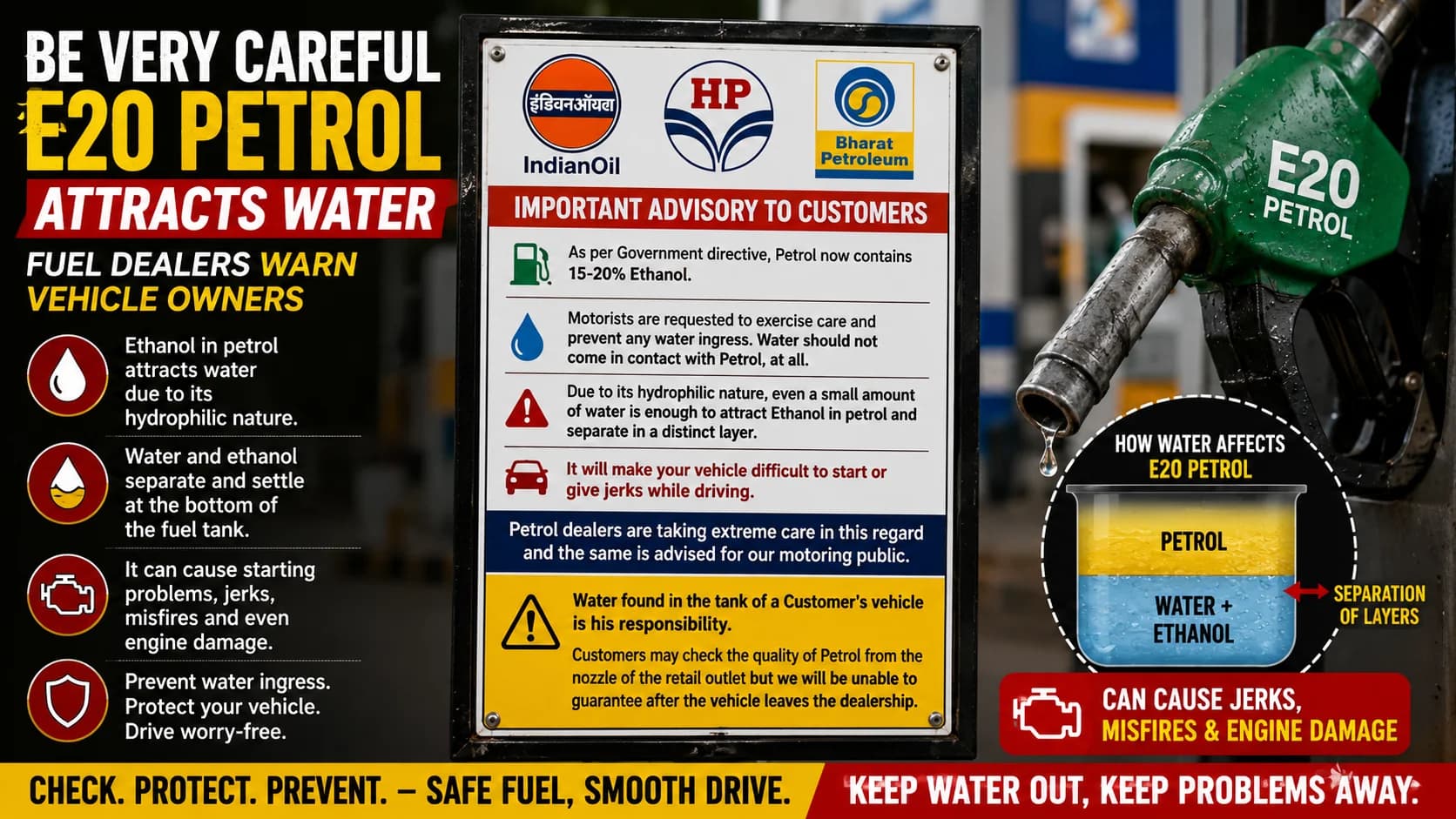
Adding a new dimension to the debate, fuel dealers across the country have started issuing warnings regarding E20 petrol and its sensitivity to water contamination. An advisory board displayed at several fuel stations has now gone viral online, cautioning motorists about the potential risks associated with water entering fuel tanks filled with ethanol-blended petrol.
The advisory highlights a critical characteristic of ethanol that many vehicle owners may not be aware of—its strong tendency to attract and absorb water.
Images circulating on social media show advisory boards displayed at fuel stations warning customers to exercise extra caution while using E20 petrol.
According to the notice, petrol sold in India now contains between 15 and 20 percent ethanol as per government directives. Fuel station operators have advised motorists to ensure that no water enters their vehicle's fuel tank under any circumstances.
The warning explains that ethanol is highly hydrophilic, meaning it naturally attracts water. Even a small quantity of water entering the fuel system can create problems.
Once water mixes with E20 petrol, the ethanol component begins separating from the petrol and combines with the water instead. This process, known as phase separation, creates a water-ethanol layer that settles at the bottom of the fuel tank.
Since vehicle fuel pumps draw fuel from the lowest point of the tank, this contaminated mixture is often the first thing sent into the engine.
The advisory specifically warns that this can lead to starting issues, rough running, hesitation, jerking during acceleration, and in severe cases, complete engine stalling.
Traditional petrol is already vulnerable to water contamination. However, E20 fuel behaves differently due to the presence of ethanol.
Ethanol molecules readily bond with water molecules. When water enters an E20 fuel tank, the ethanol separates from the petrol and combines with the water. The resulting mixture becomes denser than petrol and settles at the bottom of the fuel tank.
This means that instead of receiving clean fuel, the engine may end up ingesting a water-rich ethanol mixture.
Unlike regular petrol contamination, where small amounts of water may cause minor running issues, phase-separated E20 fuel can create much more serious problems.
This is one of the primary reasons why fuel dealers are urging motorists to take extra precautions, especially during the monsoon season.
Many vehicle owners assume water contamination is rare. However, there are several situations where moisture can find its way into the fuel system.
Some of the most common causes include:
Pressure washing or improper vehicle washing practices.
Damaged or worn fuel caps.
Faulty tank seals and filler necks.
Flooded roads during heavy rains.
Water entering during prolonged exposure to extreme weather conditions.
Condensation forming inside partially filled fuel tanks.
During India's monsoon months, the risk naturally increases, particularly for vehicles parked outdoors for long periods.
When contaminated fuel reaches the engine, the consequences can vary depending on the amount of water present.
Minor contamination may result in:
Hard starting
Rough idling
Reduced power
Poor fuel efficiency
Engine hesitation
Jerking while driving
However, larger quantities of water can lead to more serious issues.
The engine may misfire repeatedly, stall unexpectedly, or fail to start altogether. In extreme situations, excessive water entering the combustion chamber can lead to hydrolock—a condition where water prevents piston movement inside the cylinder.
Hydrolock can cause severe internal engine damage and may require expensive repairs or even complete engine replacement.
Apart from performance problems, water contamination can also accelerate corrosion inside the fuel system.
The ethanol-water mixture formed after phase separation can attack metal fuel lines, fuel injectors, pumps, and other components. Over time, this corrosion can reduce component lifespan and increase maintenance costs.
Modern vehicles designed for E20 compatibility include materials that offer better resistance to ethanol-related wear. However, prolonged exposure to contaminated fuel can still create issues regardless of vehicle type.
One aspect of the advisory that has sparked debate is the responsibility clause mentioned on the notice.
The advisory states that fuel dealers take extensive precautions to ensure fuel quality at retail outlets. However, once fuel leaves the station and enters the customer's vehicle, any water contamination found in the tank becomes the owner's responsibility.
Customers are encouraged to verify fuel quality at the dispensing nozzle, but fuel retailers cannot guarantee the condition of the fuel after it has been pumped into the vehicle.
The advisory carries the logos of India's major public-sector oil companies, including Indian Oil Corporation, Bharat Petroleum, and Hindustan Petroleum, giving it significant credibility.
For many motorists, this raises concerns about accountability if fuel-related issues arise in the future.
If water contamination is suspected, experts recommend avoiding driving the vehicle any further.
Unfortunately, conventional fuel dryer additives are often ineffective in E20 fuel systems because phase separation has already occurred.
The recommended solution involves:
Completely draining the fuel tank.
Flushing the fuel lines.
Replacing the fuel filter if required.
Cleaning affected components.
Refilling the tank with fresh E20 petrol.
Vehicle owners should seek professional assistance from authorized service centres or experienced workshops rather than attempting DIY fixes.
India's ethanol blending programme is a key part of the country's strategy to reduce crude oil imports and promote cleaner fuels. However, E20 petrol introduces new maintenance considerations that many motorists may not fully understand.
The latest warnings from fuel dealers highlight the importance of preventing water contamination, especially during the rainy season. While E20-compatible vehicles are engineered to run on ethanol-blended fuel, water contamination remains a serious concern that can lead to poor performance, corrosion, and potentially expensive repairs.
For vehicle owners, simple precautions such as ensuring a properly sealed fuel cap, avoiding unnecessary exposure to water, and maintaining the fuel system can go a long way in preventing costly problems in the future.
 News
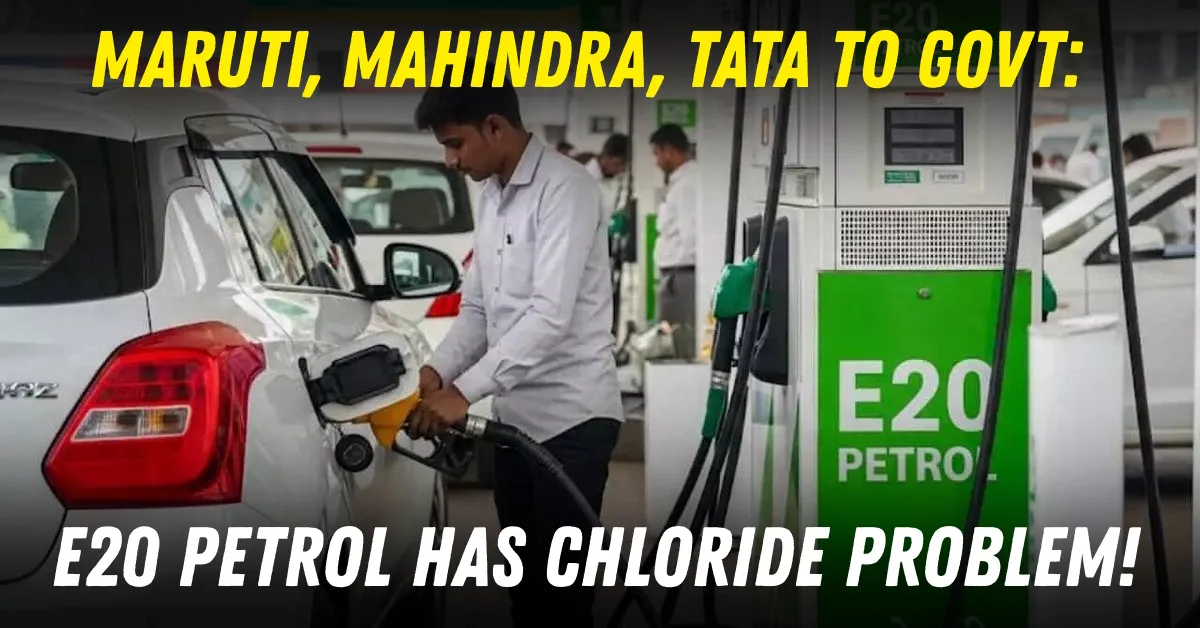
NewsIndia's biggest automakers — Maruti, Tata, Mahindra, and SIAM — have collectively raised a serious red flag: 'chloride issues' in E20 petrol. This isn't just a technical footnote; it's a direct challenge to E20's reliability and could impact your car's longevity and value.
 News
NewsA recent court order for Maruti to replace a Grand Vitara due to E20 petrol-related breakdowns sends a clear warning to Indian car buyers. We dissect what this unprecedented ruling truly means for your vehicle, E20 fuel compliance, and manufacturer responsibility.
 News
NewsOfficial data reveals Indian motorists were unknowingly using petrol with steadily increasing ethanol blends, long before E20 was formally announced. This quiet transition raises critical questions about transparency and its impact on your vehicle's performance and longevity.